
Return to the Hippo River
A month ago, five Slovaks returned from the heart of Africa – Martin Žilka (Fševed), Peter Ondrejovič (Becko), Števo Kostolanský, Miro Dušek and Ivan Bulík. They undertook once again, after four years, to float the difficult Ethiopian river Omo and document what they did not have time for four years ago – the beautiful, untouched African tribes.
The Omo – three letters to the ignorant, one of Africa’s most difficult rivers to others. It stretches from the north of Ethiopia, between huge, jagged mountains, winding through a landscape of table mountains, impenetrable bush, forest and stone walls. More than a thousand kilometres of pilgrimage await before this murky, chocolate-coloured river flows into Kenya’s Lake Turkana. After leaving the high, inaccessible mountains, she makes her way through a gently undulating landscape inhabited for centuries by untouched, African tribes. The immense isolation of these areas, their inaccessibility, deadly malaria, sleeping sickness and yellow fever have contributed to the fact that there are still human tribes untouched by civilisation. Comparing our expedition with the experience of a few years ago is sad – civilization is making its way in all ways through ethnotourism. Helicopters, jeeps on the roads, fast boats from Kenya. At the end of our expedition, Fsheved expressed a beautiful thought:
-You can reach Everest today on the back of a Sherpa, which will carry you, like a sack of rye, in a few hours by helicopter, or by the most difficult Bonnington route, the SW face, which to this day has been climbed by only a few individuals. We chose the hardest, but cleanest route.
The beat of the Ethiopian tribes slows, their uniqueness catches up. We have experienced perhaps some of the last gasps of beautiful, ancient Africa. It is predicted that within five to seven years, these beautiful, untouched tribes will no longer live there. They’ll merge into one nation, put on pants, shirts, T-shirts… Let’s appreciate the fact that we were one of the last.
Unexpected help from compatriots
Until we got to Ethiopia, we had no idea that the Slovak rubber company from Puchov has one of the most successful factories in Africa in the capital Addis Ababa. Through our friend Petr Trančík, who works there, we got to its CEO, Eng. Velic. The welcome of our compatriots was amazing. The “African” Slovaks did not turn their backs on us and accommodated every request:
-We need good quality petrol for paragliding, transport to the river and if we could somehow arrange a car from Murle, the most backward corner of Ethiopia, which is about two days away from the capital…- our requests sounded timidly. A short connection with Slovakia followed, a request for an opinion. After a few minutes a smiling ing. Velič:
-So you have our permission. In the morning we will bring you a car with everything you need for the trip.- The Slovaks did not disappoint!
Fighting the rapids
The luggage is loaded in the middle of the raft in a big pile, hastily tied, covered with a thick net. Still vests, helmets, paddles. No time to check the gear. The bystanders, who have gathered at Gibe Bridge in great numbers, are beginning to catch up. Everyone wants something – a pen, a T-shirt, money… Their aggression is gaining momentum. Even the scolding of two policemen, dressed in crumpled trousers, yellowed tank tops, doesn’t help.
-“Everybody in the boat!” roared Miro, pushing the boat away from the shore.
We stop noticing the shouting from the shore, the threats of ragged black men, the flying stones. All we have to concentrate on is the river, which is falling below us with a huge roar into the first rapids. Last minute arrangements, Miro’s instructions. Grip the paddle tightly, bare feet secured by fabric straps in the floor:
-Let’s go!-
We point the raft diagonally upstream and paddle with all our might into the middle of the river. Fševed and I sit in the front, Becko and Stevo in the back. Between us is a pile of luggage. Miro sits at the end of the boat and “reads” the river with his eagle eyes.
-Attraction Fsheved! Right take! Becko counters! Suddenly! One! One! One…- roars over the incoming thunder of feathers. We’re flying in a strong current straight into the foaming waves. The muddy river roars, grinding torrents of water, spinning huge eddies. The huge foamy river sweeps us up and carries our 600-kilogram boat, like a toy, into its bowels. We paddle with all our might. The river calms down.
-“We’re out!” we shout happily, banging our paddles. Around us, steep banks rise up into hills of dizzying height. The slopes are green, overgrown with trees and bushes.
Very difficult stretches on the river awaited us. The water was changing just as the landscape was changing. Once it was a calm, harmless river, which immediately turned into a wild, untamed element. Huge eddies, furious foam, strong currents that threw us back. In the swift current, they were able to pinch a large raft boat in one go. We remained standing, despite the fact that we were paddling with all our might. We fought the counter-current with great effort, literally inch by inch. Then the river let go and we were caught by a strong current.
Always alert
One shirt, one pants, one shorts for a whole month. On the boat, in the water, in the mud, by the fire, in a sleeping bag. The next day, again and again. Sand, dirt, muddy water, and a strong smell took up residence in every piece of luggage, clothing, pore of flesh. One can’t forget the utterance of Steve as he stood in his tattered Robinson Robinson clothes, greasy hair, overgrown face, over a pot of murky Omo water in which boiled mica floated. He stirred them disgustedly with a dirty spoon and said:
-Boys… This is not an expedition to prehistoric times. This is thirty days in the hummus!
Our camps were very hard to find on the rocky banks of the Omo. We needed wood, a platform for our tents and, most importantly, safety. That was our most important thing. Safety. Just a small mistake and we might not return home…
It was no longer the treacherous rapids, but large numbers of crocodiles and hippos that threatened us. The crocodiles were relatively less of a threat to us. They mostly fled under the surface before the big raft. There they threatened us only when we were refreshing ourselves and jumping under the rocky surface, swimming, washing. It was enough to cross their path unhappily and they would playfully snap us, like pliers through copper wire. It was worse with the hippos. They lurked unpredictably in every cove, behind large boulders, lounging on the sandy shores, blending in with the protruding rocks. They are very dangerous creatures, responsible for the most people killed in all of Africa. They dive beneath the surface and capsize a boat without warning, killing its passengers. Their aggressiveness stems from fear. If you unknowingly sail into their territory, they feel threatened. They disappear beneath the surface and attack without mercy. They are like a tank. The winner is a foregone conclusion…
We smelled death
Our menu is simple – rice with lentils for dinner, rice with dried fruit for breakfast. Here and there we interspersed it with pasta or caught fish. Drinking was taken care of all the way – the murky Omo River. For the first few days we were able to draw water from springs, which was clear in colour, but later our water supplies were reliant on the muddy river. Both of our water filters broke down on the very first day, and we were left to even boil water from the Omo, the color of which is hard to compare to any other river. It’s like a giant muddy sewer that rolls down the mountains. The sand grates under your teeth, you have to get used to the taste of mud.
The river enters the landscape of the Table Mountains. Out of the ground rise huge rock massifs whose tops are completely flat. As if someone had cut them off with a giant knife. The walls of the mountains are brick-red in colour, the flat top is covered with lush vegetation. We are floating in a backdrop of prehistoric landscapes. The only thing missing are the brontosaurs. After each bend, when the river curves around a new mountain spine, new and new horizons of these fascinating mountains appear before us.
The Omo stream was just meandering in a wide channel in the middle of the mountains. It was as if we were swimming in a lake. It had suspiciously lost its predatory quality. The raft was silent. No one said a word. We knew what was to come – huge rapids. We heard a faint murmur. It was growing louder. Soon the river was roaring. The sound was coming from a big bend, beyond which we could not see. We pulled up to the edge, went to cut instead. Huge waves, roaring masses of water, white foam swirled and rolled through the rocky canyon. Terror. The worst part was that we only saw part of the rapids. No one knew what awaited us later. The raft was silent. Miro and Fsheved were giving the last commands.
-We roared at the top of our lungs, which were soon swallowed by the huge rapids. We made the first part perfectly and avoided all the foaming cauldrons that would have swallowed our raft for good. We got to the second part, which we hadn’t the slightest idea about. The tense muscles, the regular paddle movements, the perfect rhythm, the interplay of the whole crew. It wasn’t enough. The raft was swallowed by a huge wave that none of us had anticipated.
My legs were twisted in the raft, my body was thrown into the water. The raft tilted ninety degrees. I could already see him on top of me. I was all submerged under the raging water, tossed like a rag. It took forever. The water overwhelmed me, I couldn’t breathe. Suddenly I felt that the boat hadn’t capsized, I steadied myself and my legs pulled me back. I’m in the boat! I turned back, and the others were on it. No one was sitting there. They were all swallowed up by the devilish water! Terrible feeling… My friends are dead… Only Fsheved next to me paddled on like a machine.
-Fsheved! Fsheved!- I tried to shout over the roar of the rapids, – there are only two of us left!-
He winced at the sight of the empty raft:
-For God’s sake! Go on! Makai!-he roared like an animal caught in a trap. It gave me strength, faith, woke me up to life. I was not alone. Everything remained in our hands. I fought with the paddle for my life…
The roar of the wild raptors did not cease. Yet I did not hear it, did not perceive it. Somehow I made peace with all the evil, my body was overcome by shock. We paddled with all our might. We thought only of one thing – to survive! Survive! Survive! Another, even bigger wave came. It engulfed us like a raging tsunami washing over a huge chunk of the run. I saw the whole boat come crashing down on me, a mass of foam. Once again I was left underwater. I didn’t give up and tried to get above the surface. I fought. My whole life was flashing through my head. Miraculously, our heavy boat didn’t turn around and once again fell full surface to the water. Fsheved and I stared, broken, at the empty spaces behind us. Suddenly one hand, another, someone’s head emerged from beneath the foamy surface… My heart raced. I counted. We are all! Everyone had surfaced as best they could. Those who could, paddled with us, those who couldn’t, sat shaken and coughed water. The rapids were still.
-Thank you, river, for letting us go…- We hugged each other, happy, waving our paddles above our heads.
First contacts
We got to the middle reaches of the river where the water was getting quieter. Swarms of tsetse flies carrying the deadly sleeping sickness were stinging us every second, all over our bodies. There were hundreds of them, thousands. You couldn’t shake them off. Our legs, our arms, our necks were all torn from their painful stings. They chased us for days. Suddenly their presence ended, as if they had died out. We knew we were in tribal territories! People and their cattle can live there now.
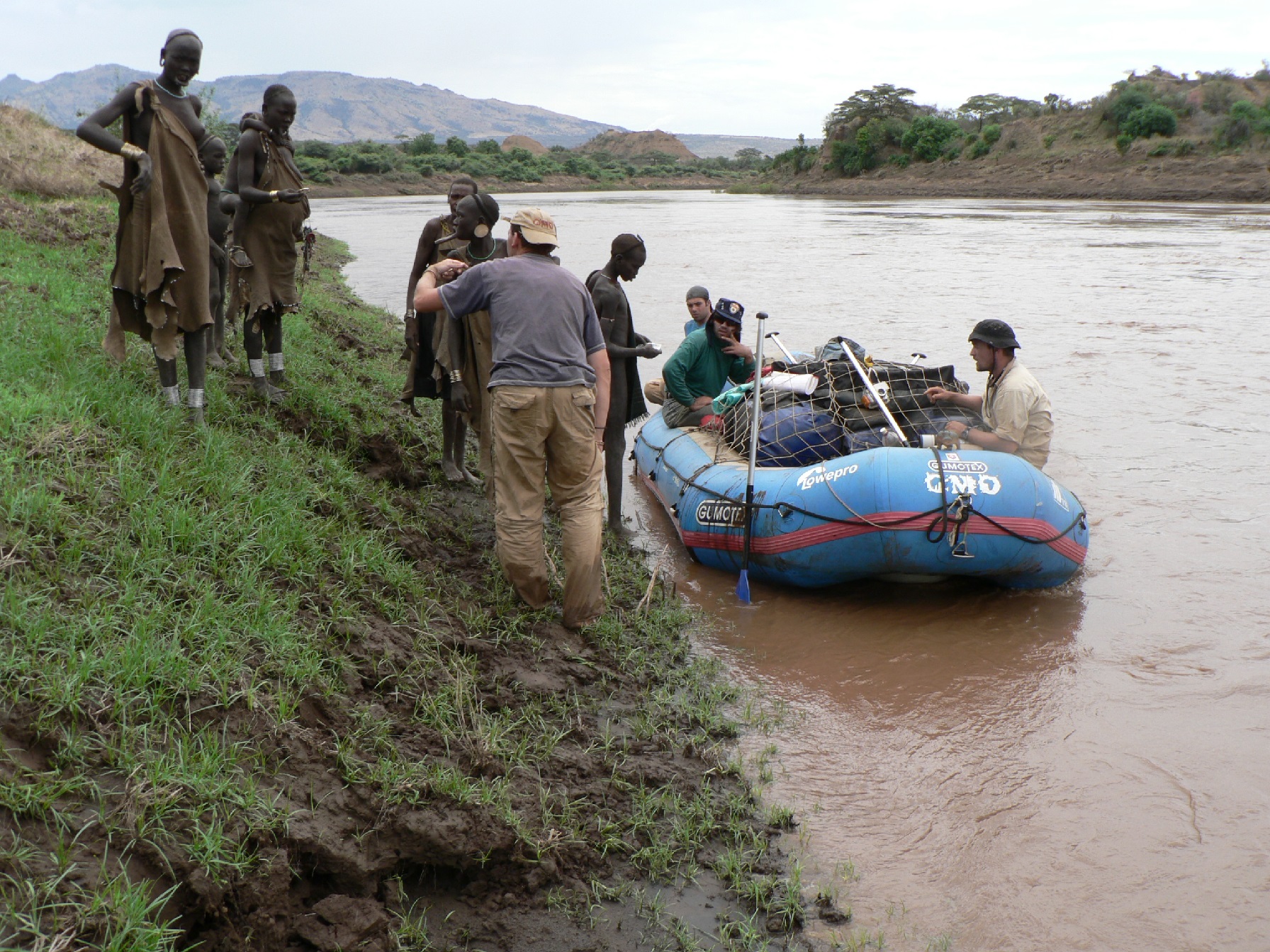
In the distance, the first canoe appeared with two black, naked men. We are entering the territory of the Bodi and Bata tribes. We meet naked warriors, men with machine guns in their hands. Each has an old Kalashnikov slung under his arm. It’s a huge paradox. Naked people at the level of a primitive society with modern weapons in their hands… The explanation is simple. For all tribes, the greatest value is cattle. It’s easier to get it with a machine gun in hand than with a spear, and anyone who wants to defend themselves against invaders must have weapons of at least the same level. And so the old, battered Kalashnikovs are flowing out of Sudan, where civil war has raged for decades, like a treadmill. Meeting an innocent boy with a heavy weapon is no problem.
Half-naked women wave to us from the shore. They are wearing only a strip of skin wrapped around their waists. Metal bracelets around their necks and arms. They are hoeing the steep slopes of the river, which they will soon turn into fields of sorghum and corn. After a few days, we reach territories belonging to the Mursi, Kwega, Bume, Karo tribes. Each tribe has its own language, different decorations, different customs. The salam greeting changes to asham, mata, later to wopó.
We arrive with smiles, small gifts – razor blades, beads, soap. Handshakes follow. It’s comical. Dirty, exhausted Europeans in tattered clothes, opposite completely naked, happy natives. They shake hands gently, like barons. They walk towards us with their hand cocked at right angles, palm clasped like true noblemen.
In the tribe of skull hunters
Some people were friendly to us, others proved to be aggressive savages. We spent several days in the dreaded Bume tribe, who are also called Skull Hunters. They made all the neighbours tremble.
Our contact began very simply. We stopped at a large bend in the Omo, where the river washed out a vast stillness. Soon the first warriors were standing by us with machine guns. They behaved friendly. We attempted something we had prepared for a long time at home and which we had not at all verified. We knew from previous visits to Ethiopia that all the tribes are obsessed with decorating their own bodies. Painted white curves on black skin, rows of earrings, scarring, heavy bracelets, rows of beads, intricate hairstyles… We pulled a hair spray out of our backpack and sprayed ornaments into one of the warriors’ hair. The others stared open-mouthed without a word. We waited for their reaction. Either see it, or… We didn’t even want to think about it. Soon the smiles came, the friendly gestures.
The tones of guitars, drums, Slovak whistles followed, Slovak songs drifted through the valley. We had endeared ourselves to the people with our simple life in the simplest of conditions, friendship and music. We managed to penetrate deeply to them, to erase their wild looks, to put off their mask of inaccessibility.
We were bound together by friendship, especially with the two men we met on their territory. Lukino and Kotol – two naked men with old submachine guns slung over their shoulders. They introduced us into the world of this beautiful tribe and we were able to fully document the life of these simple people. Straw houses clustered in circular enclosures, surrounded by fences made of huge thorns, naked children, women, men. The women boasted rows of wooden beads wrapped around their necks, their hair styled into tiny straws painted with red clay. Sagging breasts, a child on her back, a piece of skin around her waist. The men mostly had a checkered blanket draped over their shoulders, which they put away after their time with us, their naked bodies adorned only with tattoos, or the burn scars men adorn themselves with when they kill any adversary.
The “Moors” did not disappoint
Of course, we didn’t bypass the Mursi tribe either. It is a feared tribe that worries all neighbours and visitors alike. Nevertheless, it is the centre of interest for most tourists, as the women with their slit lips, in which they carry a labret, an earthenware plate, are attraction enough. To this day, the Mursi still steal, gun in hand, herds of cattle from other tribes. They will kill people without difficulty just to get at their herds, which they exchange for guns and women. On the other hand, they are already earning money through ethno-tourism in the most aggressive way. People who visit their settlements mostly do not leave their territory until they have bought themselves out. This is always accompanied by shouting, sucking, flaming, bloodshot eyes. One does not leave the Mursi and their nearby tribe, the Surmas, in peace. It quickly spread that whites carry money for photo shoots and having a cut lip is not a tradition but a necessity as a way for the tribe to make money. There are now only a few isolated settlements near Omo where the Mursi live as they once did and don’t make a living as circus performers, showing off for tourists. They too have come to know the power of money, but because there are no roads to reach them and they can only be reached by river, they are still a relatively unspoiled tribe.
The men were completely naked, large brass rings pierced through their ears, metal bracelets on their wrists. Their skin was darker than we have seen in other tribes, almost black. They were tall, thin, with long arms hanging below the waist. Their athletic bodies rippled when they walked with muscles anyone could envy. They had no hair – they shaved their heads carefully. They stared at us with bloodshot eyes from which nothing could be read. Their bare bodies were covered with ornaments, painted with white clay. The Mursi did not look friendly, and the sultry atmosphere was heightened by the submachine guns they clutched in their hands. I think if I handed them matches they wouldn’t know what to do with them, but they know how to handle machine guns like professional soldiers.
The women are the ornament and asset of every tribe, the greatest attraction for all tourists visiting southern Ethiopia. They also walk naked, with only a piece of skin around their waists. They adorn their wrists with a series of brass bracelets, their ears and necks with metal ornaments. They shave their hair, so they have no problem with hairstyles like our women. The biggest jewel is found in the lower lip – the labret – a large ceramic saucer that is inserted into the cut lower lip.
Before the wedding, the lower lip is cut open and the two bottom teeth are knocked out so that later the saucer will hold well. A small, round ceramic saucer is inserted into the sore hole. As the lip gets longer, it is gradually replaced with an increasingly larger saucer. The size of the saucer then determines how many head of cattle her family receives from the groom during courtship.
And the point?
None of us will forget the unexpected encounter with a hippopotamus on land, a surprised cobra ready to kill, the arms of the Mursi warriors that landed with pain on our chests, or the poisonous spiders that paralyzed two of our friends for a whole day after biting them… And what about the tse-tse flies, the mosquitoes from which all expeditions flee for ever… It’s all insignificant compared to what we brought home – one of the last testimonies of a dying old lady – Mother Africa.
Other articles
Return to the Hippo River
A month ago, five Slovaks returned from the heart
Expedition OMO 2005
Four years ago I experienced something special, something that
On Orinoco with Orinoco
"Put the bag over there and you sit here."
