
On Orinoco with Orinoco
“Put the bag over there and you sit here.” We all obey the commands without resistance. The hull of the little cessna crushed on the runway. I don’t even take pictures because of the strong vibrations and instinctive concern for all the flickering parts of the plane. After it hits the ground, the sloshing of the worst stops. Finally, our journey through one of Venezuela’s twenty-four states with the telling name of Amazonas begins.
Originally this was to be a challenging expedition that would test the muscles, spirit and theoretical preparation of the two-man team. Instead, our patience was tested as we climbed the not-so-successful cliffs of Bolivarian socialist bureaucracy.
With a guide enforced by Amazonas state legislation, we now sit in a small plane for four people and less than two kilograms of cargo. The pilot has two professional GPS navigators in front of him. Both off. He’s got his thick glasses on and is squinting against the morning sun with his hand. I can see it now. He’s looking for a way around the side of Table Mountain. Amazing spectacle.
San Juan de Manapiare a larger village on the Manapiare River. This is where we moved the start of plan B. Plan A didn’t work. We didn’t get permission to go to the headwaters of the Orinoco. We don’t have the funds for the bribe that solves everything here. But the hundreds of National Guard soldiers guarding the new ban on gold mining in Venezuela and suppressing the activities of the Colombian guerrillas was the most compelling argument and obstacle to considering illegal penetration.
Plan B is to go down Manapiare. This small river flows into the Ventuari, which in a delta of three hundred islands joins the Orinoco at Yapacana National Park. There we will ride down with a twelve-meter metal bong and with the strength of forty horses we will go upstream in the Orinoco waters. Where to? We’ll see. We’ll go back again with an inflatable boat to the capital of Puerta Ayacucho.
Our Czech-made boat called Orinoko from Gumotex flew with the engine two days earlier. Otherwise we wouldn’t have fit on the plane. Humberto – our Indian guide found him in a house on the main street. A very beautiful, by local standards, Indian woman, less than twenty years old, came to open it for us. “You know what Humberto? Get the contact number of the guy who’s supposed to have our gasoline on the radio. I’ll get this stuff to the port.” Before I could finish, a truck drove by. The only one in town. They pulled up on a wave. On the way, I wondered how it got here. The only transportation is by river. There was an expedition that came overland once. It was a big deal in the 50-year history of this community, but the road has long since been taken over by the forest. The river provides all the transport during the rainy season. But now, at the end of summer, it’s closed in by high clay banks. Unnavigable for larger boats carrying petrol and food. We’ve reached the river. Martin Mykiska is waiting for things at the other end of the village a few hundred metres away. I’ll blow up the Orinoco and get there by water.
“Hey are you a Gringo?” says the Indian boy. “No, I’m a European. From Bohemia.” During the conversation, I was preparing the boat for the first inflation. “You mean from Czechoslovakia? “The question knocked the inflation pump out of my hand. I thought. “Yeah, I’m Czechoslovakian.” At least I was born that way. Pushing the pump, I explained the division of our country.
“Can I try?” A little selfishly, thinking of the free hands to take pictures, I told him yes. By then, more than twenty of his friends had already crowded around us. They groped the inflated boat in disbelief, teasing me that a crocodile could easily chew through it.
First day on the water. The last waving cocoa-brown hands disappeared around a bend in the river. Now it’s just us and the river. We hold our paddles in our hands. In the country with the world’s second-largest diesel export, we couldn’t even find a litre of petrol for our six-horsepower engine. A village upriver, a young man was bitten by a snake. They didn’t have enough gas to get him to the hospital. After a week, when the swelling rose from his leg to his heart, the boy died in excruciating pain. This is also the shape of Chavez’s socialist management of gasoline here.
We know it’s a difficult situation for us too. Given the timetable and the size of the Amazonas, it is not at all certain that we will be able to return in time to catch our flight to Europe. Hopefully we can get some fuel on the way.
The first kilometres reveal the beauty of the forest, where the boat’s engine is not roaring. The animals are a lot more shy than when you’re driving the engine, but there’s more time to look around. We stop for a while to photograph orchids. Elsewhere, we pull out our paddles and cast our rods. Around us, freshwater dolphins blow geysers of water, and there, under the branches, nutria snort angrily. In short, it’s a water tramp as it should be.
It’s hard to say what makes a boat a suitable means of transport for a month-long voyage in the rainforest. Whether it’s easy handling, displacement of more than 350 kg or stability for cooking food on the stove or even urinating overboard. Anyone who has ever tried a Helios kayak knows that it is not a cruising boat at all. But in the Orinoco you can cook a stew on a gasoline tank without disaster. Catch fish on it and dance while you’re at it. I caught a pretty big piranha once. As soon as I took the rod out of the water, it bit the line and fell into my lap with a slap. Those who know them know about a mouthful of sharp teeth. In a rush of fear of losses in the most sensitive places, I started using my Uton (the ACR assault knife I had originally intended to stun it with) to drive the thrashing fish out of my crotch. It wasn’t helping, so I jumped up on the bench and tried to pin the fish with my knife and finish my original stun plan. Howling with laughter, Humberto suggested to me that this was not what the celebratory dance over catching a fish looked like.
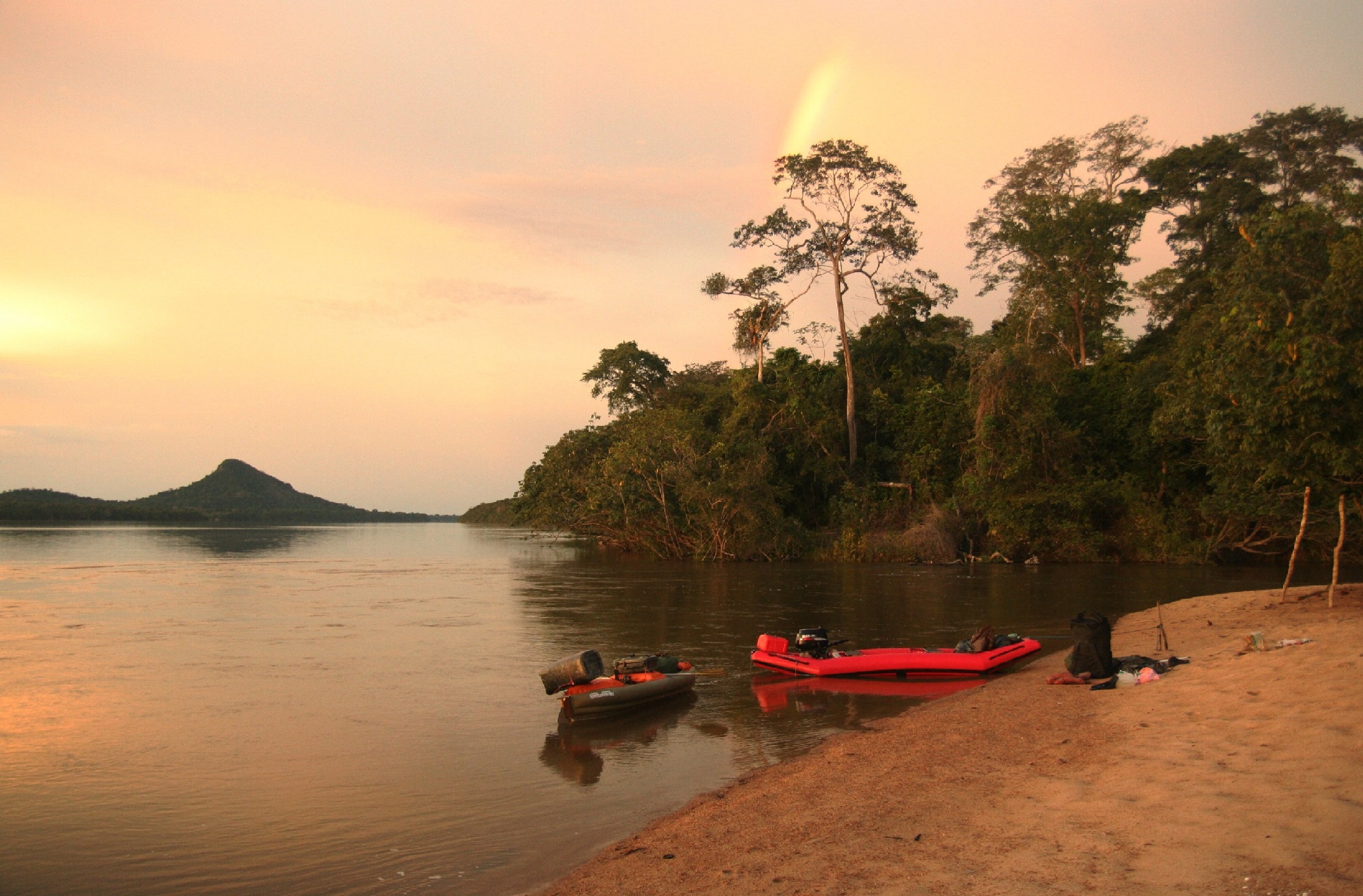
From the lightly loaded Helios kayak, the red Orinoco boat is a bizarre sight. In front, a propellerless engine leg rises from the boat like a weapon of destruction. On the hook – the first bench from the bow – sits Humberto. Behind him is a large boat bag with items for all three team members for a month of life in the rainforest waters of the Orinoco basin. On top of the bag is a suitcase with photo equipment. Always ready to open. Solar charger on the suitcase. The back bench always belongs to one of us. For most paddlers, comfort. For us, at least at first, a chore. In the Amazon, the boat is driven by the hook and the back man works. If the Indian is alone in the bong, he won’t even think of sitting anywhere else. Humberto is careful not to sit down and, out of habit, he is always pointing the boat somewhere. Usually somewhere other than me. So it ends up sideways on driftwood with sharp thorns or on sharp rocky outcrops. Fortunately, the fears of the local Indians and the fans of fixed boats at home do not come true. It’s a bit of a slog, and when the current pushes us under the branches it pops, but no bubbles. An unfortunate sign of easily solved but delaying problems.
One afternoon we stop in the shade of the forest, arching a few meters above the water. Next to a 13-metre long bong gouged out of a log. On the high bank, a group of Indians are preparing the final firing of a new ten-metre long bong. They’ve carved and carved it from a single piece of log. They call the tree the Yellow Stick, and the wood chips smell nice and strong. Actually, they won’t even burn it, they’ll just light the palm fronds inside and around it. The heated wood is good for spreading out into just the shape of a bong. “Please pass me that branch over there”, I add my hand to the work. The fire shoots high, up to the tops of the lower trees. In a few hours, it’s done. Martin and I put the kayak in the big old bong and tie Orinoco to the stern motor. We hitchhike the last ten kilometres to the village of Moriche.
In the morning we got the first litre and a half of petrol from the chief. At the pump in the hinterland, a litre of petrol costs 0.53 CZK. Here, where it’s a matter of survival, 300,-CZK. After the first half hour, the engine is running. The whole time it was bubbling, we were fitting it into the boat. The truth is that the manufacturer of the boat – Gumotex company from Breclav – states the highest possible power of the outboard motor as 2.5 horsepower (HP).
But we wouldn’t even move upstream on the Ventuari, let alone on the Orinoco River. On top of that, the smallest engine in the Carakas can be bought as a four-horsepower, and it’s the same size as a six-horsepower. Now we have a beautiful new four-stroke Suzuki engine hanging on our mirror – the plank where the engine hangs.
“Martin, please come with me.” Worried about the boat’s maneuverability, I lure my partner into the boat. A crowd of disbelieving Indians stand on the shore. They have motors, boats too, but this light red and inflatable one everyone wants to see. Especially with such a small engine! Anyone who’s ever paddled against the Ventura knows why everyone here has 30s and 40s.
The engine is bubbling. A boat in the middle of the river, with its tip upstream, stands still.
“Martin please go to the front of the bench”. It balances out the danger of going on the back when the engine kicks in. “Dan check it again, make sure it doesn’t break off and chop up the boat and us.” “Sure,” I reply. With confidence in a job well done by a Czech manufacturer, I step on the throttle. Slow and steady with an eye on the mirror grip in the boat. It’s ok. Two thirds of the boat from the tip is in the air we are flying along the surface like an arrow. They say the worst death is from fright. Personally, I think it’s worse when a propeller takes a man on the back. That’s why I’m pulling out and we’re loading.
For a loaded Orinoco with two boats, the power will be just right. We just need to line the mirror with Kevlar cord so that the long term load of full engine power doesn’t destroy the rubber-textile grips on the cylinders. Just tie the kayak behind the Orinoco, get one of us in it, and we’re good to go. We ran out of gas thirty meters before the dock of the next village. We grabbed more, twice as much for the same price. That evening we were fifty kilometers away in the village of Puerto Lemon. We got 25 litres of petrol for less than three hundred crowns. I got a fever. I was quite glad we didn’t have to paddle anymore.
Two days later we arrive at a small village with mud houses. We hope this family speaks Spanish. In the previous village, only our guide chatted. It’s lucky that the local Indians are of the Piroa tribe just like Humberto. This was a quaint village with lots of kids, so we were happy to have a chat. “Where are you going?” asked a young teacher just off shore. “Down.” Humby replied. An answer with a form of ironic obviousness is accepted here as quite sufficient. It’s like saying to someone at home: “To the Brno Exhibition Centre.” A lot of kids crowded around with a million nosy questions and a smile ready for your camera at any moment. Until we forgot to let the air out of the boats. With the nitrilon Orinoco we weren’t terrified, but the thought of losing an older type of kayak was horrible. Cooler in the morning, you inflate the boats to hard (we didn’t have a gauge with us). In the afternoon in direct sun, the compressed gas increases in volume due to the increased temperature. As long as you’re on the water, it’s fine. The boat cools down from underneath on the water. So even if you can’t keep your hand on it from above, the pressure isn’t dangerous. But if you stop, and even pull the boat onto land, an older boat could crash. That’s why we dropped it on stops like this. We’ve been here for a while. We drank rainwater with cassava (flour from the roots of the yucca) together with the Indians and talked with the teacher and the village captain. The captain is the father of nine daughters who, together with him, founded this village fourteen years ago. Today, twelve families live here. I invited some of the children on the boat. I was thinking of two or three. But seven of them got in. They grabbed paddles and binoculars right away. A pleasant atmosphere, children’s laughter and appreciative praise from the adult Indians for the stability and displacement of the unknown boat. Children jumping into the water with abandon. Without fear of the piranhas they were fishing for a while ago, as well as the caiman. They don’t come out until after dark.
It’s time to go. Find a nice camp for another warm night of mosquitoes. To new experiences tomorrow.
How’d it go? After fourteen hundred kilometers on the rivers of the Orinoco basin, we fulfilled our plan B and made it to the confluence of the Orinoco and the Ocamo River and back to Puerta Ayacucho. So the headwaters of the Orinoco are still to come. This time probably from the other side of the world. But definitely with our red boat that has worked so well this year.
Dan Hála
Other articles
Return to the Hippo River
A month ago, five Slovaks returned from the heart
Expedition OMO 2005
Four years ago I experienced something special, something that
On Orinoco with Orinoco
"Put the bag over there and you sit here."
