
Inflatable kayaks & canoe expedition on the Moisie river – Labrador/Quebec, Canada – part 2
What conclusion can be drawn from an expedition of this scale on such a wild and inaccessible river?
A technical assessment of the chosen boats – I’d like to tell you about the advantages of considering a lighter, faster and less expensive type of craft – albeit with a lower payload – than the rigid Canadian canoes traditionally used for river expeditions of this type !
Introduction 4 photos of different types of boats legends texts:
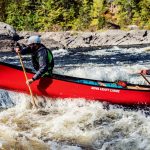
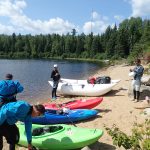
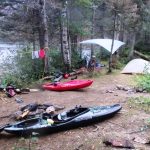
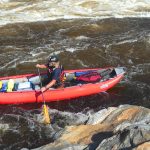
Below, from left to right, different types of boats, much more suited to whitewater than the traditional Canadian “Canot”. They are increasingly used for expeditions on the Moisie or similar remote rivers everywhere.
-
- Inflatable kayaks and canoes on the Moisie River
-
- Inflatable kayaks and canoes on the Moisie River
-
- Inflatable kayaks and canoes on the Moisie River
-
- Inflatable kayaks and canoes on the Moisie River
- Whitewater-specific “Open-canoe” – Moisie, Katachapahun (Esquif model Prospector 17 – Photo Corrine Beaulieu)
- Creekboat kayaks with PaddleCat support – Upper-Matawin (RES Paddle-Cataraft, Vincent Nicolet – Damien van Kote)
- Whitewater Kayaks with rear loading hatch – Moisie (Liquidlogic kayaks – Photo Nick Gottlieb)
- Self-bailing inflatable canoe – Moisie, final gorge, July 2024 (Baraka Gumotex model – Olivier Arch)
THE COSTS: RENTING RIGID CANOES LOCALLY vs FLYING WITH YOUR OWN INFLATABLE
By using our own Gumotex kayaks and inflatable canoes, we totally avoided the expense of renting canoes or kayaks for 4 weeks – considering that if you rent in Quebec City for a complete 412 km descent of the Moisie over 3 weeks, you’ll need a total of 4 weeks for logistics: getting the kayaks or rigid canoes to Sept-Iles, waiting there for a train (only two trains a week), the obligatory costs of renting cars to transport these canoes from Quebec City to Sept-Iles and back after the trip, the obligatory costs of transporting the canoes/kayaks on the train to the head lakes departure of the canoe-trip.
Based on July 2024 rental rates, total cost per head BASED ON 5 PEOPLE, direct flight from France to Sept-Iles:
- Rental of 2 two-seater canoes and one single-seater canoe with paddles/flights/1 barrel 60lt/pers: 533 CanD/head
- Car rental type VUH 5 pl. insurance, A.R Sept-Iles-Québec two days, before the trip: 447 CanD , fuel 202 CanD
- Freight cost of a canoe or kayak on the Tshiuetin train, Sept-Iles – Oreway: 150 CanD per boat x 3/5 = 90 Can D/head.
- Car rental type VUH 5 pl. insurance, Sept-Iles-Quebec two-day return trip, after the trip: 447 CanD , fuel 202 CanD
- Purchase or rental of roof racks for 2 canoes + 1 kayak: 330 CanD (Ss-total vehicle and related expenses: 326 CanD/head)
Total costs to expect if you RENT rigid boats: 533 + 326 + 90 = 949 CanD/pers.
MORE ECONOMICAL WITH YOUR OWN INFLATABLE… if you you weight your pack carefully !
By comparison, we brought our GTX canoes on our flight from France to Sept-Iles – it would have been the same for a flight to Labrador-City – for only the cost of checked bagage weighing less than 50 lbs/23 kg (Lufthansa + Air-Canada) – 75 euro one-way, 150 euro round-trip.- Then once there, there were no extra charges for our boats (still compressed in their bags) – neither on the train, – nor in the seaplane – since in both cases, we were entitled to 3 bags for a total weight of 100 pounds (46 kg).
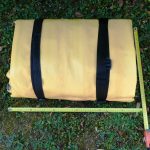
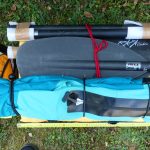
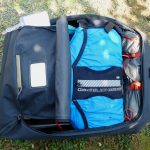
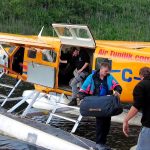
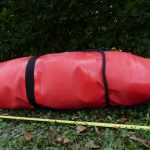
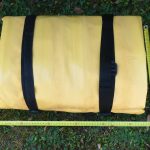
HOW TO PACK ? Instructions on photos below, from left to right:
-
- Inflatable kayaks and canoes on the Moisie River
-
- Inflatable kayaks and canoes on the Moisie River
-
- Inflatable kayaks and canoes on the Moisie River
-
- Inflatable kayaks and canoes on the Moisie River
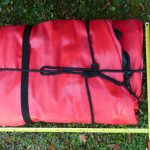
- My K2 folded and compressed 55 x 38 x 21 cm, 17.7 kg
- My K2 + a 4-part paddle, a Drysuit XL, a helmet, a throwline
- All in an overbag, + a B.A, a fleece, a repair-kit, and… my tent !
- The same overbag, finally on the banks of the Moisie !
Links: canoe rental Quebec https://canotslegare.com/liste-prix Tshiuetin train: https://www.tshiuetin.net/infos-voyages/
Links: canoe rental Quebec https://canotslegare.com/liste-prix Tshiuetin train: https://www.tshiuetin.net/infos-voyages/
THE PADDLING with SELFBAILING INFLATABLE vs TRADITIONAL “CANOT”
On our 271 km trip on the “Main-Moisie”, there are exactly 60 rapids marked on the maps (including 2 falls and not counting the “riffles”), of which 16 are gr.3, 9 gr.4 and 5 gr.5. We ran all the rapids except the two falls and two of the “gr.5” rapids (due to excessive hydraulics caused by the high flow the days we hit them), and we “chicked” another cl.5, making a total of 4 portages and one “chicken-shoot”. But If you read the reports on traditional canoe expeditions on the Moisie, you’ll realize that much more portages are often listed, varying between 10 and 20…14 portages being indicated on our maps between km 271 and the finish.
Below is a canoe map of the Moisie between km 230 and 220, a long section with 14 rapids – in red the rapids from class 3 or more. 3 long portages are indicated by —- but 4 others are recommended by red text – “canots” carrying out all these indicated portages (a total of 1520 m) should therefore expect a long day to run these 10 km ! Thanks to our self-bailing inflatables, we were able to shorten the trip by making a single portage (424 m) and a 30 m “suitcase”: it took us 3 hours for 10 km, including 1.5 h for the 424 m portage, instead of a very long day !
Right photo below: our portage with an empty Baraka weighing just under 20 kg.
-
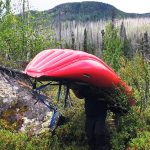
- Inflatable kayaks and canoes on the Moisie River
-
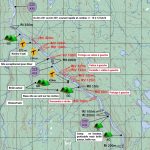
- Inflatable kayaks and canoes on the Moisie River
WHY GUMOTEX BOATS ?
Our conclusion from these reports is that the big rapids of the Moisie appear easier to run with self-bailing inflatables, of the type used by many rafting companies around the world on similar rapids, (with on board paddlers often being at the beginning of their practice and therefore generally not (yet) whitewater experts).
I’d say that IF these inflatables are extremely strong, and IF designed for whitewater, they will probably be lighter, more efficient craft for expeditions on these rugged rivers, even over long distances, although their load capacity is less than that of a traditional rigid open canoe, and although they are somewhat slower on flat sections of river or when crossing lakes.
There are several inflatable manufacturers offering quality boats, specially designed for “difficult” white-water conditions, and reliable for expeditions: in the USA, NRS, Hyside and Sotar produces inflatable rafts and kayaks coated with hypalon or polyurethane. But these raft and kayak manufacturers don’t produce … CANOES !
Fortunately, in Europe, we have two producers of elastomer-coated inflatables – Gumotex in the Czech Republic, Grabner in Austria – and each of them produces certain models of kayaks AND CANOES specially designed for serious whitewater, AND quite performant in terms of speed on calm water, by the way some models are operational for long-distance trips or expeditions.
With over 30 years’ experience with Gumotex boats and their indestructible home-made-elastomer-coating -“NITRILON”, we have found these qualities to be at the highest level in the models we have chosen for our expedition, as their specific features meet the same priority criteria, as follows:
SPECIFIC ADVANTAGES OF GUMOTEX BOATS
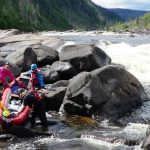
The photos below show the specific wear and tear that inflatable boats undergo on expeditions: dragging loaded boats (sometimes twice their empty weight) through bush, over cut fir branches and over boulders or granite slabs, would totally abrades and/or completely destroys, very quickly, any PVC-coated inflatable boat.
No other inflatable fabric coating on the market can beat Gumotex’s Nitrilon: its formidable “indestructibility” against abrasion and UV rays induces their incredible longevity, proven every day by thousands of families around the world who have been using the same Gumotex boat every season for… two, sometimes even three… generations !
-
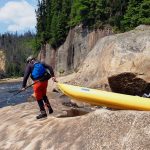
- Inflatable kayaks and canoes on the Moisie River
-
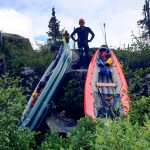
- Inflatable kayaks and canoes on the Moisie River
-
- Inflatable kayaks and canoes on the Moisie River
SAFETY WITH GUMOTEX
When it comes to safe white-water paddling, especially in rivers with large volumes of water, you need a specific shape for your inflatable boat that will enable the boat to overcome water movement and retaining holes, while allowing your craft to keep the speed and momentum generated by the paddler(s).
Remember, if you don’t have a “more than reliable” inflatable boat for an expedition in a remote area, according to the two essential criteria – strength and shape – mentioned above… YOU SIMPLY RISK YOUR SKIN !! or THAT OF ONE OF YOUR TEAM-MEMBER, in the event of an accident !!
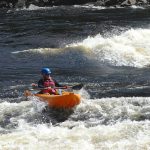
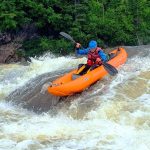
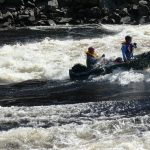
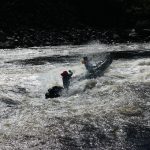
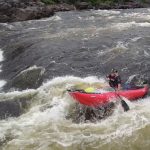
The photos of our K2 and Scout models below, show how easy they are to get over ledge-holes or breaking waves without getting buried, while maintaining their directional stability and speed:
-
- Inflatable kayaks and canoes on the Moisie River
-
- Inflatable kayaks and canoes on the Moisie River
-
- Inflatable kayaks and canoes on the Moisie River
-
- Inflatable kayaks and canoes on the Moisie River
PADDLING WITH GUMOTEX:
No other kayak or inflatable canoe on the market offers the combination of Curve-shape, Rocker, and Volume, which characterizes the Scout, Baraka and K2 models we’ve chosen, and which has probably saved us several times from dramatic capsizes in big rapids in the middle of nowhere: what more could you ask for?
(please consult the models’ “technical specifications” for more detailed technical data: https://drive.google.com/drive/folders/1cR1ZkrESlc8torTlAatuZseF3i2JfNEs
Or: http://www.canoekayak.fr/content/category/9-cahier-technique).
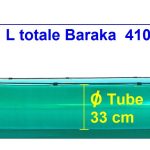
Below: Bow volume and instant water evacuation on the Baraka – the hull profile of this model, particularly well-suited to big rapids.
-
- Inflatable kayaks and canoes on the Moisie River
-
- Inflatable kayaks and canoes on the Moisie River
FLIGHT COST SAVINGS WITH GUMOTEX BOATS
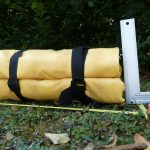
No other inflatable of similar size can compact like a Gumotex – you’ll have seen from the attached photos that my checked baggage on the flight contained not only my K2 kayak, but also my equipments: a 4-part kayak paddle, a 90N buoyancy aid, a helmet, a repair kit, a carry bag, a dry suit… and my tent ! All this in less than 158 cm (L+W+H added together), for a weight of 22.9 kg (standard for checked baggage on most airlines). This compactness is due to Gumotex’s Nitrilon – thanks to the density and flexibility of this unique rubber-based elastomer coating !
I should point out that my colleagues with their Baraka and Scout also managed to compact their boat to the required dimensions and weight, and were therefore also able to fly with their boat as “checked baggage” at no extra cost.
-
- Inflatable kayaks and canoes on the Moisie River
-
- Inflatable kayaks and canoes on the Moisie River
-
- Inflatable kayaks and canoes on the Moisie River
-
- Inflatable kayaks and canoes on the Moisie River
From left to right: photos 1 & 2 bare Baraka with a single seat 19.8 kg – photos 3 & 4 bare K2 with 1 dropstitch seat 17 kg
SOME BOATS SPECIFIC CUSTOM OUTFITS
… and a super-comfortable expedition accessory!
-
- Inflatable kayaks and canoes on the Moisie River
-
- Inflatable kayaks and canoes on the Moisie River
-
- Inflatable kayaks and canoes on the Moisie River
-
- Inflatable kayaks and canoes on the Moisie River
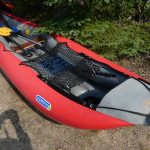
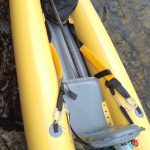
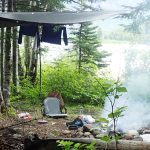
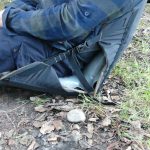
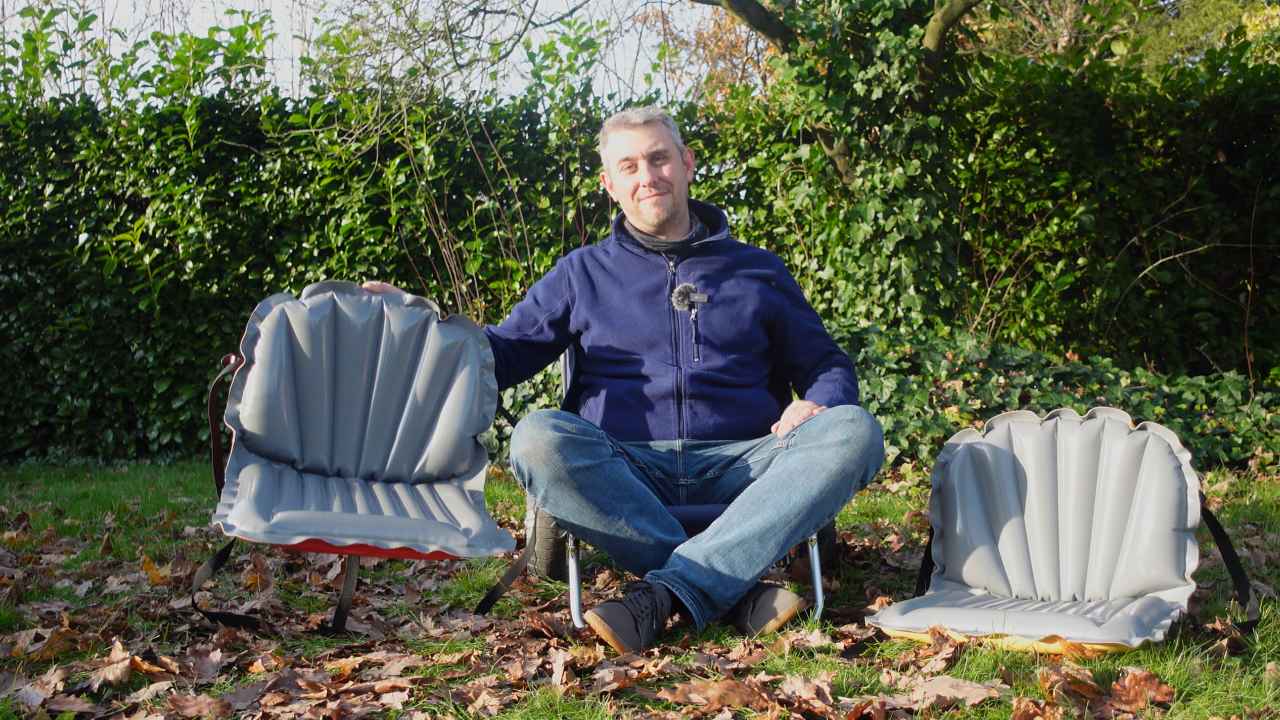
Ph.1 K2 with mono seat and thigh braces Ph.2 Central bench and nets on the Baraka Ph.3 & 4 GTX camp seat
Article written by: Laurent Nicolet, August 17th, 2024
Photos: Laurent Nicolet, Pierre Dabout, Philippe Dabout
Other articles
Seawave and safety
Paddling back into a shelter, even when one (or two!) side-tubes are punctured!
Being able to paddle to a shelter, even when the floor of your Seawave is punctured!
Seawave overturned in the open sea – emptying, righting and climbing-in!
Gumotex and field testing: a win-win for everyone
Hi, I'm Matthes from Germany. For some time now, I've had the privilege of testing new Gumotex products before their official release.
Lipno Sport Festival 2024
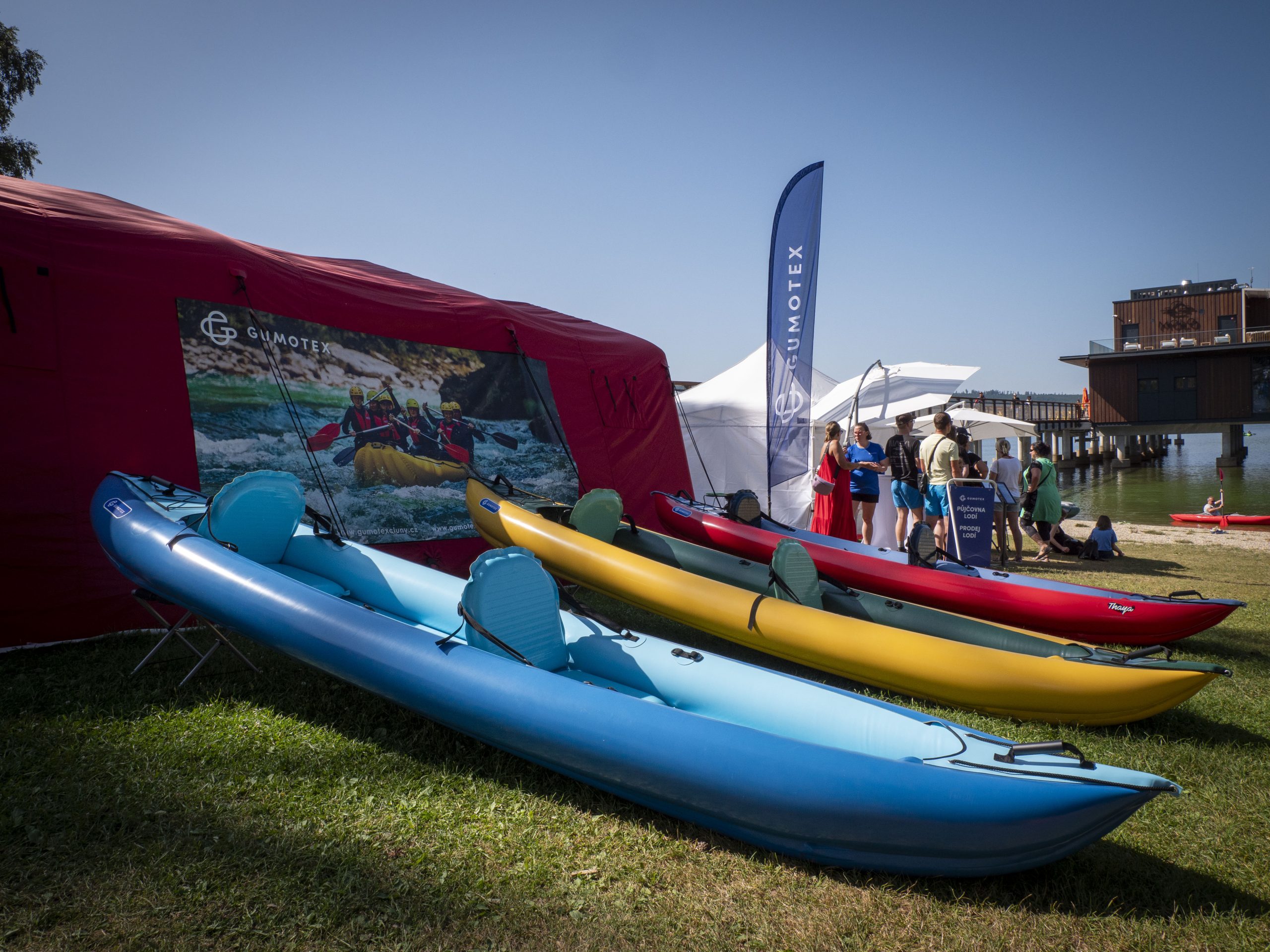
This year we were again (for the third time) among the providers of good mood and great experiences at the Lipno Sport Festival, which was visited by around 50,000 enthusiasts from all over the world.
